
Uttar Pradesh Chief Minister Yogi Adityanath asserted that Uttar Pradesh enjoys a clean environment, unlike Delhi, which he likened to a 'gas chamber' due to its pollution levels.

On the weather front, dense fog led to a sharp drop in visibility, with Palam recording 50 metres visibility under dense fog conditions with west-southwesterly winds at 5 kmph at 8 am, while Safdarjung reported 100 metres visibility with calm winds at the same time.

Delhi's air quality deteriorated to the 'severe' category, prompting the implementation of Stage-IV GRAP measures and hybrid classes for schools.

Delhi choked under a thick blanket of smog on Monday, with the Air Quality Index (AQI) settling at 498, which falls in the higher spectrum of 'severe' category.

A thick layer of toxic smog enveloped the national capital on Saturday as air quality deteriorated sharply, prompting the Commission for Air Quality Management (CAQM) to invoke the strictest curbs under Stage IV of the Graded Response Action Plan (GRAP) across Delhi-NCR.

The Commission for Air Quality Management (CAQM) has revoked restrictions imposed under GRAP 3 in Delhi-NCR following improvements in air quality. Non-essential construction and demolition activities are now allowed to restart, and restrictions on vehicles have been lifted.

Delhi experiences a biting chill with 'cold day' conditions and dense fog, coupled with 'very poor' air quality. The IMD forecasts continued cold weather and potential light rain.

'If a common man wants to buy an air purifier for Rs 10,000, then he will have to shell out Rs 11,800 with 18 percent GST.' 'If he is charged GST at 5 percent the same air purifier will cost Rs 10,500.' 'This saves a one time amount of Rs 1,300 -- and that too just to breathe clean air.'

Pulmonologist Dr Harish Chafle highlights when and why you must not ignore a common cough.

A workable, doable 'to-do' list for the New Year...

Chief Justice of India considers shifting Supreme Court hearings to virtual mode due to severe air pollution in Delhi after experiencing its effects firsthand.

The Delhi High Court has directed the GST Council to consider lowering or abolishing the goods and services tax on air purifiers, citing worsening air quality in the national capital. The court has asked the council to meet at the earliest, even via video conference if necessary, to address the issue.

The Supreme Court on Wednesday asked the Commission for Air Quality Management (CAQM) to consider directing schools in Delhi-NCR to postpone open air sports competitions planned in November and December to 'safer months' keeping in mind air pollution levels.
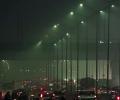
Delhi government mandates 50% work from home for offices and private establishments under GRAP stage three due to severe air pollution. Essential services are exempted.

The Delhi High Court has asked the central government why it cannot reduce the GST on air purifiers, considering the poor air quality in Delhi. The court's concern is that the current 18% GST makes air purifiers unaffordable for the common man.

As the year winds down, regardless of what it may have been, the belief is that the next year will be better, and that is what gives December its edge.

The India Meteorological Department (IMD) reports that ash clouds from volcanic activity in Ethiopia, which impacted flight operations in India, are drifting towards China and will move away from India by 7.30 pm on Tuesday.

Interest in green living is rising, with clean air and open spaces becoming key selling points for residential projects, particularly as Indian cities struggle with deteriorating air quality.

Delhi's air quality improved for the second consecutive day on Thursday, with the Air Quality Index (AQI) recorded in the "moderate" category at 165. This marks a significant improvement from the "poor" category recorded on Tuesday. Several restrictions imposed under Stage 4 of the Graded Response Action Plan (GRAP) were lifted, but some restrictions under Stage 2 remain in place. The Decision Support System (DSS) has not been updated since Friday, with technical difficulties hindering the update of data for the last six days.

The first cloud-seeding trial has been conducted in parts of Delhi, including Burari and Karol Bagh areas, aimed at inducing artificial rain to tackle air pollution.

Air quality index (AQI) soared past 350 level in parts of Delhi on Thursday and experts cautioned that as weather turns colder it may breach the 400-mark ceiling and enter the 'severe' zone soon, notwithstanding the incidents of stubble burnings which have nosedived from 17,529 in 2020 to 4,262 this year.

Heavy rains lashed Delhi, leading to a red alert, traffic snarls, and waterlogging. The IMD predicts continued rainfall.
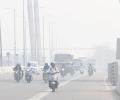
'I think pollution levels have been rising in Delhi for the past 10-12 days. We can feel it in our eyes today. The smog is dense'
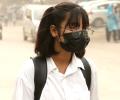
Dr Sneha Tirpude, pulmonologist at Pune's Ruby Hall Clinic, suggests simple measures to protect your lungs when the air quality is poor.

As many as 12 flights were diverted at the Delhi airport between 3 pm and 4 pm due to adverse weather conditions, an official said.
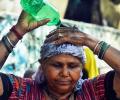
Temperatures are likely to remain in a similar range until Thursday, with a gradual fall expected from June 13.
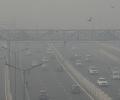
Delhiites continued to breathe toxic air on Tuesday as the air quality edged closer to the severe zone in some areas.
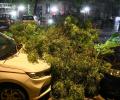
A strong dust storm and gusty winds followed by rain hit Delhi-NCR on Friday evening, causing trees to be uprooted in several parts and leading to traffic congestion. Thunderstorms caused power disruptions in several parts of the city, primarily due to trees and branches falling on electricity cables. The India Meteorological Department (IMD) has issued an orange alert, recommending people stay indoors and avoid unnecessary travel.

Delhi's air quality plummeted to alarming levels on Tuesday after 24 days, with many areas witnessing a significant spike in pollution despite the strictest measures, including a ban on construction activities and the entry of trucks into the city, coming into force.

Delhi's air quality deteriorated significantly on Monday, with areas like Dwarka, Mundka and Najafgarh recording an AQI of 500, the worst this season. The city's overall AQI reached 491, triggering the implementation of the Graded Response Action Plan (GRAP) Stage-IV restrictions in Delhi-NCR. Doctors warned of health risks, urging people to wear N95 masks and avoid outdoor activities. The Supreme Court questioned the Delhi government on its anti-pollution measures and warned against scaling down preventive measures without its permission. Delhi Chief Minister Atishi accused the BJP-led central government of political maneuvering while neglecting stubble burning in states it governs. Meanwhile, the city enforced stricter pollution control measures, including a ban on truck entry and suspension of construction activities. Air purifier sales surged, reflecting the public's concern over the severe air pollution.
The city's 24-hour Air Quality Index, recorded at 4 pm every day, stood at 418, up from 334 the previous day, and it may trigger stringent restrictions under the third stage of the graded response action plan to mitigate hazardous conditions.
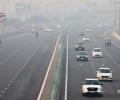
The city's 24-hour Air Quality Index (AQI), recorded at 4 pm daily, stood at 417, making it the worst in the country. On Friday, the AQI level was 396.

According to Ministry of Earth Science's air quality monitor 'SAFAR', the air quality is likely to improve from Friday onwards due to better wind speed.

Dense fog enveloped Delhi for a second consecutive morning, leading to disruptions in air and rail traffic. Visibility dropped to zero in several areas, causing delays for 81 trains and diversions for 15 flights. The Met office attributed the fog to calm surface winds, and predicted continued dense to very dense fog throughout the day. Meanwhile, the national capital's air quality remained in the 'very poor' category, with an AQI reading of 380 at 9 am.
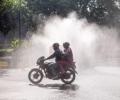
This deterioration in air quality led to prompting enforcement of Stage II of the Graded Response Action Plan (GRAP) in the national capital.
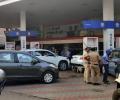
The Delhi government has announced that vehicles older than 15 years will be denied fuel at petrol pumps starting April 1.

The monthly Rs 2500 payment for poor women is expected to cost Rs 11,000 crore while the pension scheme of Rs 2000 for every senior citizen will cost around Rs 4100 crore. The Yamuna clean up will cost over Rs 10,000 crore while a similar amount is required to upgrade Delhi's hospitals. Ultimately, the new BJP government will have no choice but to ask the centre for financial support, notes Rashme Sehgal.

The Delhi government has ordered half of its staff to work from home, urging private organizations to follow suit as the national capital faces an alarmingly high level of air pollution. The move comes as Delhi recorded an Air Quality Index (AQI) of 426 in the "severe" category, with residents reporting health issues. Essential services will continue to operate at full capacity. The government has also advised companies to provide shuttle bus services for employees and suggested that private entities consider shifting office hours to reduce traffic congestion.

Gaps in enforcement, limited monitoring, and easy access to firecrackers from the NCR region where restrictions were slack were largely responsible for the widespread flouting of the cracker ban in Delhi on Diwali, experts have opined.

After a long and harsh spell of heatwave, Delhi witnessed a pleasant morning on Thursday, with the weather department saying parts of the national capital received light rains.
 © 2026 Rediff.com - Investor Information - Advertise with us - Disclaimer - Privacy Policy - Sitemap - Feedback - About us - Terms of use - Grievances